Inside the Table · June 9, 2026
How to Beat a Calling Station
A calling station calls too much and folds too little. Beating one is boring and brutal: bet your good hands bigger, and almost never bluff. Here's how, with live examples from the table.
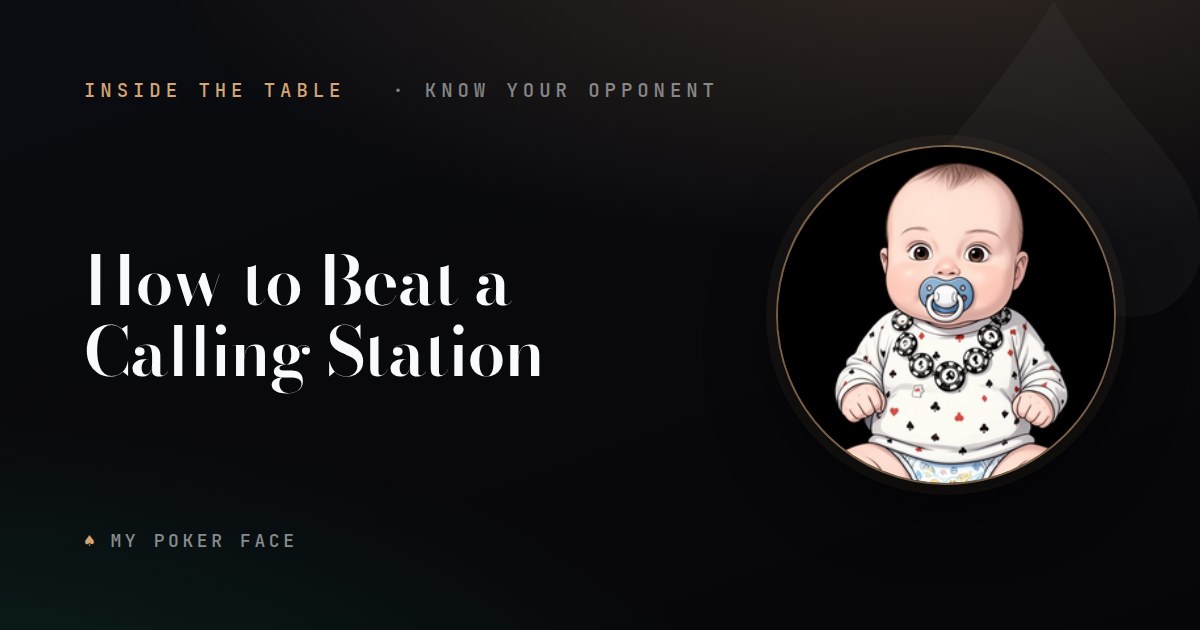
A calling station is the player who will not fold. You bet, they call. You bet bigger, they call. You fire the river with a busted draw and a prayer, and they look you up with second pair and a guilty smile. If you have ever felt like an opponent was personally insulting your bluffs, you have met one.
The good news: the calling station is one of the only player types you can beat with a plan that fits on a napkin. Bet your strong hands bigger than feels comfortable, and bluff almost never. That is most of the article. The rest is knowing how to recognize the variants, because “calls too much” comes in a few different flavors, and two of them will cost you money if you treat them like the textbook version.
What a calling station actually is
A calling station plays loose and passive. Loose means they enter too many pots and see too many flops. Passive means that once they are in, they call far more than they raise, and they fold far less than they should. Put those together and you get a player who treats every hand as a question (“what have you got?”) and pays to find out.
Two consequences follow, and they point in opposite directions.
First, bluffing a station is close to lighting money on fire. A bluff only works if a better hand can fold, and folding is the one thing a station refuses to do. Save it.
Second, a station is one of the most profitable opponents in poker, because they pay off the hands you actually want them to pay off. Against a good, tight player, your strong hands win small pots because they get out of the way. Against a station, the same hands win big ones.
The core adjustment: value, then more value
Everything you do against a calling station bends toward one idea: get maximum money in when you are ahead, and stop donating when you are not.
- Bet your good hands, and size up. Stations are price-inelastic. They are not doing the math on pot odds, so a bigger bet does not scare them off. A solid made hand (an overpair, top pair with a decent kicker, two pair) is a three-street value bet by default: bet the flop, bet it again on the turn, and bet the river too. The time to ease off is an ugly runout, where a flush or an obvious straight fills and a station who calls everything finally has the hand that beats you. On a clean board, keep firing.
- Value-bet thinner than usual. Against most players, a marginal hand like top pair with a weak kicker checks at least one street to keep the pot small. Against a station, it bets, because worse hands call. Ask the question “what worse hand pays me off here,” and against a station the answer is usually “plenty of them.”
- Put the bluffs away. Not entirely. A station who has shown they can fold a little is worth one bluff now and then. But your baseline should be: no bluffs until proven otherwise.
- Do not get fancy. Slow-playing a monster is how you let a station off cheap. They were going to call your bet anyway, so make the bet.
What the plan is actually worth
This is not just theory. The bots in My Poker Face play out full hands by the thousands in simulation, so the edge can be measured directly instead of argued about. We sat three disciplined styles heads-up against a pure calling station, several thousand hands each across repeated runs:
| Your style | Win rate vs a calling station |
|---|---|
| Tight and aggressive (value-heavy) | +125 bb/100 |
| Very tight, low aggression | +76 bb/100 |
| Tight and passive | +46 bb/100 |
Win rate here is in big blinds per 100 hands, the standard yardstick for poker results. For perspective, a strong human win rate in a tough game is a few big blinds per 100. Against a calling station, the disciplined value-bettor wins more than a hundred, because the station pays it off three streets at a time.
The order is the lesson. All three styles beat the station, but the aggressive one wins close to three times what the passive one does. The difference is the betting: waiting for premiums and checking along still turns a profit, but it leaves most of the money in spots a station would gladly have paid off. Bet your hands.
The draws problem
The main way a passive caller costs you is draws. A station that calls everything also calls with flush draws and straight draws, and sometimes those get there. The fix is the same fix: bet, and bet enough. If you let a draw-heavy board check through, you are giving a free card to the one player at the table guaranteed to take it. Charge the draw. If they call a big bet and the flush comes in, that is poker, but you made them pay a bad price to get there, and over time that price is your profit.
The other way is subtler: a range that never folds sometimes simply has it. Stations turn up with two pair, sets, and dominating kickers more often than feels fair, so when one keeps calling into a scary runout, give them credit and shut it down. That is the same instinct as the ugly-runout exception above, and it is the reason thin value has a ceiling: keep firing your good hands, but do not talk yourself into the bet that only ever gets called by something better.
How calling stations show up in My Poker Face
You do not have to wait for one to wander into your game. The roster is full of them, and you can spot one before you sit down: open any opponent’s page and read the playing profile. A tall Looseness bar with a short Aggression bar is a calling station in two glances.
The classic passive station. A Baby, Alice, Jesus, Santa Claus, and Frankenstein’s Monster all play the textbook version: they see every flop, rarely raise, and are very hard to bluff off a hand. These are the seats where the napkin plan prints money. Bet your value, three streets, sized up, and resist the urge to get clever. They will pay you. They are also, not coincidentally, some of the most pleasant opponents at the table, which is exactly what makes people pay them off out of politeness.
The draw-chaser. Friar Tuck calls like the rest of them but loves to chase a draw to the river. Against him the lesson is the draws section above: do not check, do not give the free card, make the draw pay.
The sticky maniac (the variant that flips the script). This is where people lose money. Don Quixote, Captain Ahab, and Zeus are sticky like a station, so they will not fold, but they are also wildly aggressive: they call and they barrel. If you treat them like a passive station and bet your medium-strength hands into them, you walk into raises and overbets with the kind of one-pair hand that wanted a calmer pot. Against this type you flip one piece of the plan for everything that is not a monster. Keep the “almost never bluff” rule, but stop trying to do the betting yourself with marginal value. Check those hands to them, let them fire, and call down lighter than you normally would, because their range is full of air they refuse to give up on. With a genuine monster you are still happy to get raised, so go ahead and build the pot. It is the medium hands you check, to keep the pot small and induce the bluffs they cannot help making. You are still collecting value. You are just letting the maniac build the pot for you.
The stubborn tight-station. Winston Churchill looks like the opposite of a station: he is tight and patient and folds plenty. But once he commits to a hand, he will not be moved off it. The read here is range, not frequency. When a loose station calls you down, their range is wide and weak and you can value-bet thin. When Churchill calls you down, his continuing range is narrow and strong, so the thin value bets that crush A Baby are the ones that pay him off instead. Drop the thin bets and the bluffs against him, keep betting your genuinely strong hands, and respect it when he will not go away. Same stickiness, very different hand.
The coach in practice mode will flag these spots for you while you play, including the moments you are about to bluff into someone who has never folded in their life. It is a fast way to build the instinct.
The one mistake everyone makes
Tilt. A station calls your beautiful bluff with bottom pair, and the natural human response is to do it again, harder, to prove the point. That is the exact move that turns a profitable opponent into the one beating you. The calling station is not daring you to bluff. It just cannot hear you. Bet your hands, fold your air, and let the math do the talking.
Find a high-Looseness, low-Aggression seat, value-bet relentlessly, and keep the bluffs in your pocket. Take a seat and try it, or browse the full roster and read the profiles before you buy in. Half the edge is just knowing who you sat down with.